
How to start a tutoring business
Make a clear offer, plan your prices and find your first students. Use an editable launch plan to prepare your tutoring business for its first paid lessons.
Starting a tutoring business begins with a few decisions you can test: who you will teach, what they will pay for, how you will reach them and how you will organize the lessons. A clear first offer is more useful than an elaborate plan built around students you have not found yet.
This guide is for your own paid practice or small tutoring company, including an online or home-based business. Work through the decisions below and put your answers in the editable tutoring business launch plan (TXT).
In this guide:
Choose your students and tutoring offer
If you are considering how to become a tutor, begin with the subject and learners you can help confidently. Specify their level, the problem they want to solve and how your lessons will help. Offer lessons that match your knowledge, experience and relevant qualifications.
For example, an offer might be: "Weekly one-to-one online maths lessons for students ages 12 to 15. We work through difficult school topics and practise solving problems independently." A parent can understand the audience, purpose and format without decoding a list of services.
Decide whether you will teach independently or organize other tutors. Choose private lessons, groups or both. For an online tutoring business, consider how students will join lessons and receive materials. For home-based tuition, consider suitable space, travel, privacy and applicable premises requirements.
Keep the first version manageable. A focused offer is easier to explain, schedule and improve after conversations with real students.
Starting an online tutoring business
An online tutoring business still needs its own offer, clients and payment rules. Choose a video-call service and a simple way to share practice tasks and files, then decide where bookings and lesson changes will be recorded. Check that students can use the tools on their devices. Confirm the time zone and joining details in the lesson confirmation, especially when teaching across borders. Before your first paid session, test sound, screen sharing and access to materials with another person. The aim is a lesson students can join confidently, with a clear record of what they have booked.
Write a one-page tutoring business plan
Your first tutoring business plan should help you make decisions this month. Write down:
- Students and offer: the subject, learner level, format and reason someone would choose it.
- Weekly capacity: teaching slots you can actually deliver, alongside preparation and other commitments.
- Prices and costs: your lesson price, ongoing expenses and initial spending.
- First students: one or two ways to reach suitable learners and a clear contact route.
- Working rules: cancellations, payment timing and who handles each task.
- Review date: when you will compare the plan with actual inquiries, bookings and costs.
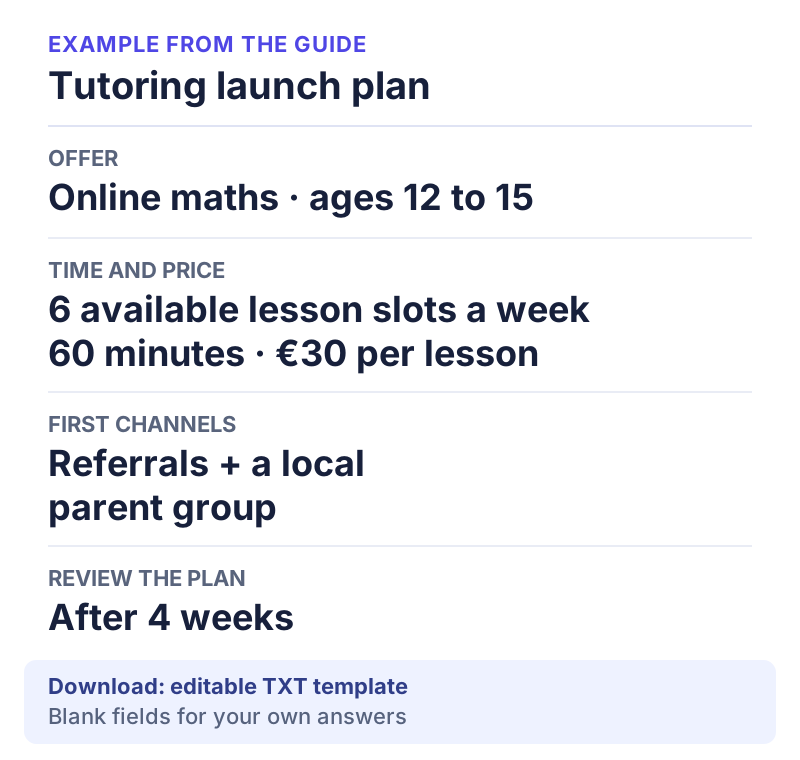
Consider a small part-time start alongside another job. An illustrative plan could be: a solo online maths tutor, six available teaching slots each week, a price of €30 for a 60-minute private lesson, referrals and a local parent group as the first contact channels, and a review after four weeks. These are planning choices, not suggested market rates or a forecast of bookings.
Use the editable one-page launch plan to make your own version. Save the TXT file and replace the bracketed prompts. A useful plan exposes an unanswered question, such as how many paid lessons your available hours can support.
Set tutoring prices and lesson rules
A lesson price needs to cover more than time in front of the student. Include preparation, follow-up, travel where relevant, room or software costs and time spent communicating or organizing work. A timetable with six available slots does not mean all six will be booked from launch.
Compare the income from a realistic number of paid lessons with your expected costs. Keep initial spending and recurring expenses separate, and allow for your own income and tax obligations. Review your figures as actual bookings arrive instead of treating the initial plan as a guaranteed result.
In this part-time example, six weekly slots give at most 24 lessons in a four-week planning month. At €30 each, that is €720 before costs and tax. If monthly costs are €120 and you need €600 before tax for your own work, all 24 lessons must be paid. There is no room for empty slots. Check that preparation fits around those lessons, then revise the price, costs or capacity if the plan leaves too little margin. These figures illustrate a decision, not typical earnings or expected bookings.
Agree the practical rules before lessons begin:
- How long is a lesson, and what is included in its price?
- When is payment due, and how will students receive the payment information?
- What happens when a student cancels, misses a lesson or asks to reschedule?
- Who confirms a change, and where will the agreed decision be recorded?
Attendance and payment are different questions. An absence does not by itself explain whether a fee is due. A clear policy, applied consistently and within local requirements, helps you explain the amount on the student's bill.
Check local requirements before you launch
Registration, tax, safeguarding, insurance, premises and privacy obligations depend on your location and how you operate. Your subject, learners and working arrangements also affect the checks you need to make. Gather the relevant answers before taking bookings, particularly when working with children or from your home.
Use official guidance for your country rather than relying on another tutor's experience elsewhere:
- United States: the SBA's business-launch guidance is a starting point for business setup and relevant local checks.
- United Kingdom: start with GOV.UK business setup. For safeguarding checks, use the appropriate scheme for your location and role; see the DBS guidance for eligible self-employed people.
- Canada: use the government's guide to starting a business.
- Australia: use the official starting-a-business guide.
- Ukraine: Diia's individual-entrepreneur registration service provides an official registration starting point.
- Germany: the federal business-startup portal provides official startup information.
Check relevant qualifications and any professional certification against the actual work you plan to offer. Record the official source and what you still need to confirm in your launch plan. A general checklist cannot settle the requirements of every location or teaching arrangement.
Find your first tutoring students
Choose a small number of contact channels where your intended learners already look for help. Personal referrals, relevant local organizations and appropriate community groups can provide a starting point. Explain who you help and invite a conversation about the learner's needs.
A simple tutor website or public profile should answer:
- Who are the lessons for, and which subjects or levels do you cover?
- What experience or qualifications support your offer?
- Are lessons online, in person or both, and where do they take place?
- What are the lesson format, price and next step for making contact?
Give a prospective student or parent a reason to trust your teaching. Share a short example of how you explain a task, describe your relevant experience and explain what happens in the first lesson. Use real examples and experience that fit the students you want to teach.
Choose a clear business name and keep it consistent across your page and communications. The first goal is a credible offer and an easy way to contact you. Ask what brought each inquiry, note the learner's needs and follow up as agreed. That gives you a basis for improving the offer and deciding where to spend more effort.
For the maths offer above, a first message could be: "I offer weekly 60-minute online maths lessons for students ages 12 to 15. We work through difficult school topics and practise solving problems independently. Send me your child's age and the topics they find difficult, and we can discuss a suitable time."
For one first-channel test, ask to post that message in a relevant local parent group where tutoring offers are allowed. Include one email address or contact form. Note each inquiry, whether the learner matches your subject and level, and whether a lesson is agreed. Review after a week, then decide what to change in the message or channel.
For the first conversation, prepare questions about the learner's current level, goal and availability. Confirm the proposed lesson and price in writing so the student or parent knows what happens next.
Organize lessons, student invoices and teacher earnings
Once students book, keep one dependable record of the agreed lessons, prices, changes and money received. Regular lessons need a schedule that students and tutors can follow. If a student takes both private and group lessons, the billing record should make the combined amount understandable.
This is where tutoring business management software can help. Intelligence Cloud connects the lesson schedule, attendance and student billing. It automatically creates student invoices from your prices when your school publishes its approved schedule. Your school decides whether a missed lesson is charged. Once that decision is recorded, the system reflects it in the student's invoice.
Intelligence Cloud includes recorded payments in the student's balance, so the owner can see what remains unpaid and explain which lessons make up a bill. See the tutoring billing guide for a concrete example.
If another tutor joins, agree their rate and calculation basis separately from the student's price. Intelligence Cloud calculates teacher earnings from the lessons and agreed rates, so the total can be explained from the underlying records.
You can explore the product with demo data without registration. Inspect which lessons make up an invoice and how recorded payments affect the balance. If you choose to create your own Intelligence Cloud workspace, the first month is free and no card is required.
If you already teach and keep student records in spreadsheets, you can start with one group or a short schedule, check the results and move the rest when you are ready.
Check you are ready for the first paid lesson
Use this final checklist to turn the plan into a working first week:
- Your offer identifies the learners, subject and lesson format.
- The price, payment timing and cancellation rules are clear to the student or parent.
- Relevant local requirements have been checked, with any necessary actions completed.
- There is a way to find your offer and contact you.
- The lesson time, place or online joining details have been confirmed.
- Someone is responsible for the schedule, received payments and changes to charges.
- You have set a date to review inquiries, bookings, costs and feedback.
Complete the tutoring business launch plan, then choose the next action that makes your first paid lesson possible. A small, organized launch gives you real experience to build on.
Related resources
Tutoring Center Billing Software
Intelligence Cloud creates student invoices automatically from your lesson schedule. It brings charges, received payments and unpaid balances together, so staff can explain each bill without rebuilding monthly spreadsheets.
Evaluate training center software with demo data
Follow one student from a lesson and attendance to an invoice and recorded payment. Check the amounts before entering your own school data in Intelligence Cloud.
Start using school software without moving all your data
Already teaching with student records in spreadsheets? Start with a small part of your existing work before moving the rest.
See how your tutoring business could run
Open a student invoice in the Intelligence Cloud demo and see how its lessons make up the amount. Explore the sample data without registration, or start free to create your own workspace.
Compare software plans and pricing